Living with Bronchiectasis
Bronchiectasis is a chronic, progressive lung condition affecting infants, children and adults. While the global prevalence of bronchiectasis is not accurately known,1 there is a growing awareness of the disease.2

About Bronchiectasis

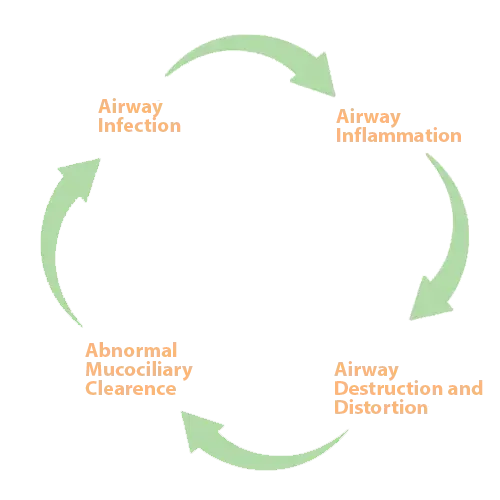
Bronchiectasis is characterized by permanently widened or dilated airways (know as bronchi) with thick walls and scarring. Your airways produce mucus (also called sputum) to help trap and remove germs and particles that enter your lungs. Tiny hair-like structures called cilia help move mucus out of your airways up to your throat to prevent infection. Bronchiectasis damages your cilia, so your airways can’t clear themselves properly. When this happens, mucus builds up in pockets in the widened airways and attracts bacteria – leading to a chronic cycle of lung infections and inflammation, and further damage to your airways.

There’s no cure for bronchiectasis – but treatment can help you manage your condition. Most people diagnosed with bronchiectasis have a normal life expectancy.3

Types of Bronchiectasis

Bronchiectasis affects people of all ages. You can be born with the condition (called congenital bronchiectasis) or you can acquire it later in childhood or as an adult as a result of another condition or factor that damages your lungs or increases your risk of lung infections (this is known as acquired bronchiectasis).5 Bronchiectasis isn’t contagious.6

The likelihood or risk of getting bronchiectasis increases with age.7 Most people newly diagnosed with bronchiectasis are adults.8 It’s not a common condition in babies or children, but they can be affected.8

Bronchiectasis may affect many areas of your lung (diffuse) or appear in only one or two areas of your lungs (focal).9

There are two kinds of bronchiectasis – bronchiectasis that is unrelated to cystic fibrosis (commonly called non-CF bronchiectasis) and cystic fibrosis bronchiectasis (CF bronchiectasis).10
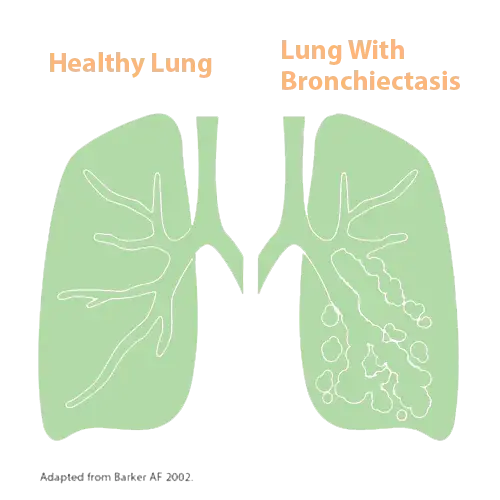
healthy lung vs lung with bronchiectasis
cycle of bronchiectasis

Causes of Bronchiectasis

Causes of bronchiectasis include:11

  • Primary ciliary dyskinesia (PCD), a genetic condition that affects the cilia in your airways. Cilia are tiny, hair-like structures that move back and forth to move mucus out of your airways
  • Past respiratory infection such as pneumonia, tuberculosis, whooping cough and measles
  • Immunodeficiency disorders such as common variable immunodeficiency (CVID) and human immunodeficiency virus (HIV)
  • Connective tissue diseases (CTD) such as rheumatoid arthritis and Sjogren’s syndrome
  • Allergic bronchopulmonary aspergillosis (ABPA), a form of lung disease that occurs in some people who are allergic to Aspergillus fungus. The reaction causes swelling in your airways
  • Non-tuberculous mycobacteria (NTM), a family of common organisms found in water and soil that can cause lung infections
  • Chronic obstructive pulmonary disease (COPD)
  • Severe asthma
  • Inflammatory bowel disease (IBD), such as ulcerative colitis and Crohn’s disease
  • Recurring pulmonary aspiration, when you inhale a foreign substance such as food, liquid, saliva, or stomach acid into your lungs
  • Alpha-1 antitrypsin deficiency (A1AT), a genetic disorder that can affect your lungs
  • Congenital (you are born with the condition)
  • The cause is unknown – this is called idiopathic bronchiectasis
  • CF Bronchiectasis is related to having cystic fibrosis. Cystic fibrosis is a genetic condition that causes an abnormal production of thick and sticky mucus in the lungs and other parts of the body

Signs, Symptoms and Diagnosis

Symptoms and signs of bronchiectasis in children and adults include:

The most common symptom in bronchiectasis is cough

Common Symptoms

  • Persistent cough
  • Coughing up a lot of clear or coloured mucus or sputum. Colour can be an indicator of the presence of bacteria13
  • Feeling run-down or tired
  • Shortness of breath (breathlessness) that’s worse during flare-ups, also known as exacerbations
  • Wheezing
  • Coughing up blood or mucus mixed with blood, a condition called hemoptysis

Diagnosis

Tests used to diagnose bronchiectasis in children and adults include:14

  • Chest CT scan (computed tomography scan) to look at your lungs in more detail 
  • Mucus (sputum) culture to check for growth of bacteria
  • Blood tests to check for conditions associated with bronchiectasis, infection and low levels of infection-fighting blood cells
  • Bronchoscopy to look inside your airways. This procedure uses a small camera on the end of a tube called a bronchoscope
  • A sweat test or other tests to diagnose cystic fibrosis
nurse with mask points to an x-ray of the lung

Scoring systems for bronchiectasis can help your doctor to identify if you’re at higher risk. The Bronchiectasis Severity Index (BSI) uses a combination of clinical, radiological and microbiological features to assess the severity of your disease and to predict future risk of mortality, hospital admissions, exacerbations, and quality of life.15

Non-Medication-Based Treatment

Common Treatments

Bronchiectasis is a long-term condition. Early treatment is important to help improve how you feel and to keep your condition well managed. If left untreated, your symptoms may progress causing further damage to the airways in your lungs.16

Treatment goals for bronchiectasis in children and adults are: 5,17

  • Treat lung infections
  • Clear mucus from your lungs through airway clearance therapy
  • Prevent further damage
  • Reduce your symptoms
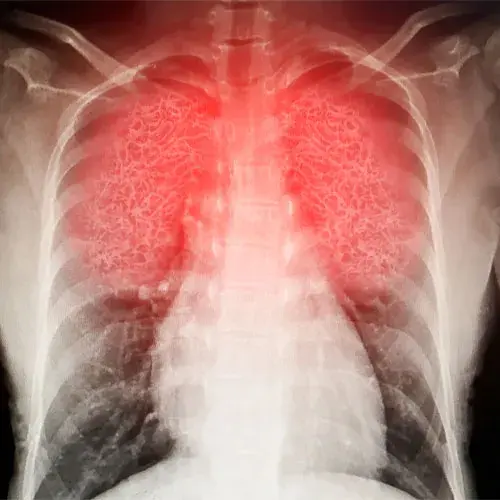
red lungs in x-ray

Airway Clearance

Airway clearance is an important way to manage bronchiectasis in infants, children and adults. Airway clearance therapy (ACT) uses non-invasive techniques to help loosen mucus or sputum so it can be cleared from your airways by coughing or huffing.

There are many different airway clearance techniques. It’s important to speak with your health care provider to find the type and frequency of treatment that’s best for you or your child.

Chest physical therapy or physiotherapy (CPT), also known as postural drainage and percussion (PD&P) is performed by your health care provider or care giver.11,18 You’re placed in several different postures or positions to help drain mucus from different parts of your lungs using gravity. Percussion or clapping on your chest wall is done by your care provider to help move the mucus into your larger airways so it can be coughed out. This technique is suitable for infants and small children who are not yet old enough to cooperate with more active techniques. It’s also an option for those unable to use or too fatigued to use independent techniques.18

Self-administered airway clearance techniques include:

Autogenic drainage (AD)11,18 

Autogenic drainage uses a cycle of controlled breathing exercises to clear different levels of your lung. This technique moves mucus from the small airways to the medium-sized airways and then to the larger airways to be coughed out.

Active cycle of breathing techniques (ACBT)11,18 

Active cycle of breathing techniques combines breathing control, deep breathing (thoracic expansion) exercise and huffing (forced expiration technique) performed in a cycle.

Oscillating positive expiratory pressure (OPEP) therapy11,18 

An OPEP device is a handheld device that combines positive expiratory pressure (PEP) with oscillations (or vibrations) to help clear secretions from your airways. As you exhale through the mouthpiece, positive pressure holds the airways open and allows air to get behind the mucus. Oscillations help to thin, loosen and move the mucus to the larger airways of your lungs where it can be coughed out.

Positive expiratory pressure (PEP) therapy11,18 

A PEP device is a handheld device that creates positive pressure when you exhale through the device’s mask or mouthpiece. The positive pressure holds open the airways in your lungs, allowing air to get behind the mucus and loosen it so you can cough it out.

High frequency chest wall oscillation (HFCWO) therapy11,18 

In this technique external chest wall oscillations are applied to your torso using a fitted vest. The vest produces vibrations to help loosen and thin mucus and separate it from your airway walls so it can be coughed up.

Intrapulmonary percussive ventilation (IPV)11,18 

This technique uses a pneumatic device to deliver short bursts of air into your lungs at a high rate. These percussive bursts of air are delivered during inhalation and exhalation and help to loosen and mobilize secretions to your upper airways where they can be coughed out.

Exercise

Pulmonary rehabilitation exercise and education programs can teach you the skills to help manage your symptoms.19 You should speak with your health care provider about the type and intensity of exercise suitable for you.

Nutrition and Diet

Nutrition is important in managing your overall health. People with bronchiectasis may have unintentional weight loss, be underweight and at risk of malnutrition.20 A nutritionist or dietician can help you improve your diet and maintain a healthy weight.7

woman using aerobika

Managing Mucus Clearance

There are many techniques that can be used to assist with bronchiectasis.

If you are producing excess mucus, different techniques like deep breathing & huff coughing may help you clear the excess mucus.

Devices like the Aerobika* OPEP device are simple hand-held drug free devices, which could help to clear the mucus.4

Medication-Based Treatment

Bronchodilators

Bronchodilators are drugs that relax and open your airways, so air can flow more freely into your lungs allowing you to breathe more easily. Bronchodilators are used before an airway clearance session to help with mucus clearance. Salbutamol (or albuterol) is a commonly used bronchodilator that is inhaled using an inhaler (puffer) and a valved holding chamber or a nebulizer.

Mucus Thinners

Hypertonic saline is a sterile saline solution with a salt (NaCl) content of 1% or higher that is used to hydrate and loosen mucus, making it easier to cough up. Hypertonic saline is inhaled using a nebulizer.

Antibiotics

Antibiotics prevent, treat or control lung infections caused by bacteria such as Pseudomonas aeruginosa that grows in the mucus. Antibiotics may be given by mouth (orally), by inhalation using a nebulizer or inhaler or intravenously (IV).

Vaccinations

Influenza (flu) vaccines may help reduce the chance of complications to your condition from bacterial infection.19

Surgery and Organ Transplant

Lung surgery may be considered if you have bronchiectasis in a limited area of one lung and have not responded to other treatments.3 Lung transplantation may be a viable therapeutic option if you have very severe bronchiectasis and no other treatment options.3

References

  1. International Respiratory Coalition. Lung Facts - Diseases - Bronchiectasis. https://international-respiratory-coalition.org/diseases/bronchiectasis/ (Last accessed January 17, 2024).
  2. Martina Contarini. Bronchiectasis: a case-based approach to investigation and management. European Respiratory Review 2018;27:180016. https://err.ersjournals.com/content/27/149/180016.
  3. Living with Bronchiectasis. British Lung Foundation 2017;BK33 Version 1. https://www.blf.org.uk/sites/default/files/BK33_Bronchiectasis_v1_2017_PDFdownload.pdf (Last accessed January 17, 2024).
  4. Alan F Barker. Bronchiectasis. The New England Journal of Medicine 2002.;346:1383-1393. https://www.nejm.org/doi/full/10.1056/NEJMra012519.
  5. Bronchiectasis. National Heart, Lung, and Blood Institute. https://www.nhlbi.nih.gov/health-topics/bronchiectasis (Last accessed January 17, 2024).
  6. Bronchiectasis Frequently Asked Questions (FAQs). Bronchiectasis and NTM 360°. https://www.bronchiectasisandntminitiative.org/Learn-More/I-am-a-Patient-or-Caregiver/Bronchiectasis-FAQs (Last accessed February 23, 2024).
  7. Doreen Addrizzo-Harris, et al. Living Well With Bronchiectasis Patient Information Guide. CHEST Foundation 2017. https://foundation.chestnet.org/wp-content/uploads/2020/05/Bronchiectasis-Living-Well.pdf (Last accessed January 17, 2024).
  8. Bronchiectasis in children. British Lung Foundation. https://www.blf.org.uk/support-for-you/bronchiectasis-in-children/what-is-it (Last accessed January 17, 2024).
  9. Galit Livnat, et al. Non-cystic fibrosis bronchiectasis: review and recent advances. F1000 Medicine Reports 2009;1:67. https://www.ncbi.nlm.nih.gov/pmc/articles/PMC2948306/.
  10. Jaafer Saadi Imam, Alexander G Duarte. Non-CF bronchiectasis: Orphan disease no longer. Respiratory Medicine. 2020;166:105940. https://www.sciencedirect.com/science/article/pii/S0954611120300809
  11. Adam T Hill, et al. British Thoracic Society Guideline for Bronchiectasis in Adults. Thorax 2019;74(1):1-69. http://dx.doi.org/10.1136/thoraxjnl-2018-212463.
  12. Bronchiectasis in children. British Lung Foundation. https://www.blf.org.uk/support-for-you/bronchiectasis-in-children/what-is-it (Last accessed January 17, 2024).
  13. MP Murray, et al. Sputum colour: a useful clinical tool in non-cystic fibrosis bronchiectasis. European Respiratory Journal 2009;34(2):361-364. https://erj.ersjournals.com/content/34/2/361.
  14. How is bronchiectasis diagnosed? British Lung Foundation. https://www.blf.org.uk/support-for-you/bronchiectasis/diagnosis (Last accessed January 17, 2024).
  15. Severity assessment. EMBARC The European Bronchiectasis Registry. https://www.bronchiectasis.eu/severity-assessment (Last accessed January 17, 2024).
  16. Bronchiectasis: Symptoms. National Jewish Health. https://www.nationaljewish.org/conditions/bronchiectasis/bronchiectasis… (Last accessed January 17, 2024).
  17. What is the treatment for bronchiectasis? British Lung Foundation. https://www.blf.org.uk/support-for-you/bronchiectasis/treatment (Last accessed January 17, 2024).
  18. Annemarie L Lee, et al. Airway-Clearance Techniques in Children and Adolescents with Chronic Suppurative Lung Disease and Bronchiectasis. Frontiers in Pediatrics 2017;5(2):1-8. https://doi.org/10.3389/fped.2017.00002.
  19. Eva Polverino, et al. European Respiratory Society guidelines for the management of adult bronchiectasis. European Respiratory Journal 2017;50:1700629. DOI: 10.1183/13993003.00629-2017. https://erj.ersjournals.com/content/50/3/1700629.
  20. Bronchiectasis Toolbox. https://bronchiectasis.com.au/bronchiectasis/living-with-bronchiectasis… (Last accessed January 17, 2024).